Why Your Essay Conclusions Are Losing You Points (and What to Do Instead)
You just finished the body of your essay. Your arguments are solid. Your evidence is in place. Then you write a conclusion that summarizes everything you already said. It feels flat. You hand it in. Your grade comes back lower than you expected. That sinking feeling is familiar to many students. The conclusion is where essays either land with impact or fade away. If you are losing points on your finals and term papers, the culprit is often your closing paragraph. The good news is that fixing it is straightforward. You do not need to rewrite your entire paper. A few targeted changes can transform your conclusion from a weak ending into a powerful finish.
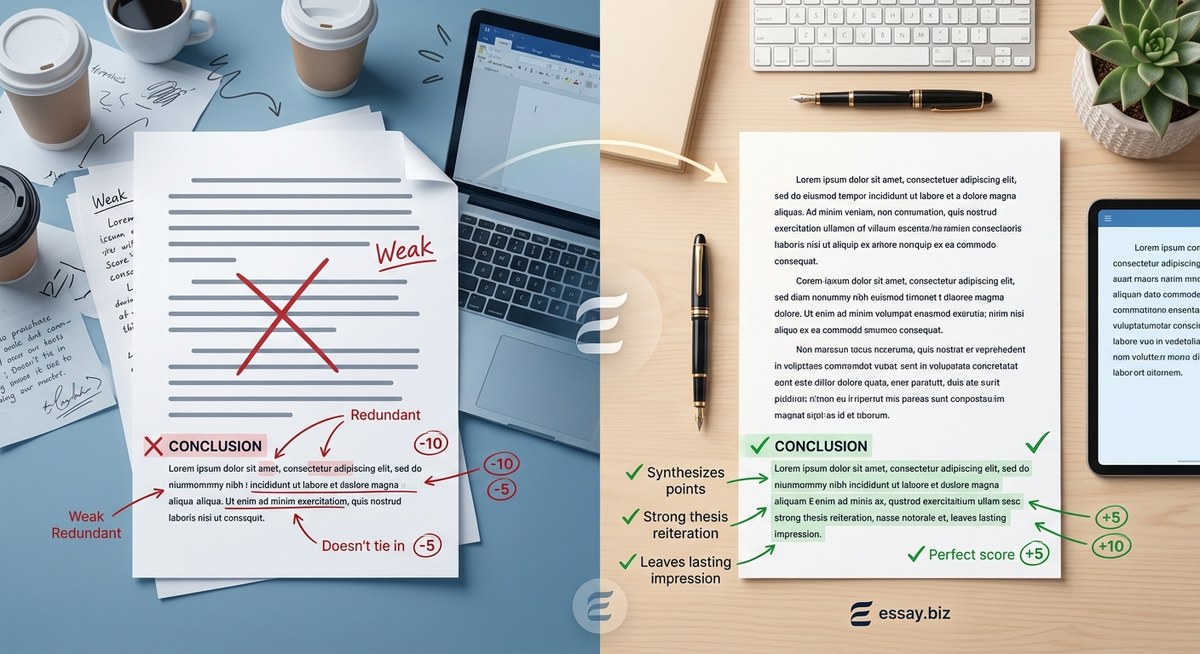
A strong essay conclusion does more than restate your thesis. It reinforces your main argument, answers the “so what?” question, and leaves the reader with something to think about. The most effective conclusions use a simple three-part structure: revisit your thesis with fresh language, synthesize your key points, and end with a forward-looking statement or call to action. Avoid introducing new evidence, using cliches like “in conclusion,” or apologizing for your argument. When you master this formula, you will earn back the points you have been losing.
Why Weak Conclusions Cost You Points
Teachers and professors see dozens of essays each semester. They read strong introductions and well-organized body paragraphs. Then they hit a conclusion that sounds like a robot wrote it. The most common weak conclusion moves are:
- Restating the thesis word for word
- Listing each body point again with no synthesis
- Ending abruptly without a final thought
- Using phrases like “in conclusion” or “to sum up”
- Introducing a brand new idea or fact
These patterns signal that the writer ran out of steam. They also suggest you do not fully understand the purpose of a conclusion. A conclusion is not a repeat button. It is your last chance to reinforce your argument and show the grader why your essay matters. When you miss that chance, you leave points on the table. The difference between a B and an A often comes down to those final three sentences.
What a Strong Conclusion Actually Does
Think of your conclusion as the final scene of a movie. The best endings do not just replay the plot. They give you a new perspective on everything that came before. They make you feel something. They leave you thinking.
A strong essay conclusion does three things:
- It refreshes your thesis without repeating it.
- It pulls together your main points in a way that shows how they connect.
- It answers the “so what?” question. Why should anyone care about your argument?
When you get these three elements right, your grading rubric lights up. You show critical thinking. You demonstrate control over your material. You leave a lasting impression.
A Three-Step Process for Writing Your Conclusion
You do not need to guess anymore. Use this numbered process every time you write an essay. It works for high school assignments, college applications, and even graduate papers.
Step 1: Rewrite Your Thesis with Fresh Language
Go back to your thesis statement from the introduction. Read it. Now close your eyes and explain the same idea to a friend in your own words. Write that down. You want the core claim to stay the same, but the phrasing should be different. Avoid opening with “In conclusion” or “To summarize.” Just state your refreshed thesis directly.
For example, if your original thesis was “School uniforms reduce bullying by removing visible economic differences,” your rewritten version could be “When students wear the same clothes, economic markers fade and bullying based on appearance drops sharply.”
Step 2: Synthesize, Do Not Summarize
Do not list your three body paragraphs in order. Instead, show how they work together. Imagine you are connecting dots. Each body paragraph is a dot. Your conclusion draws the line that completes the picture.
A good way to do this is to ask yourself: “What is the single most important takeaway from all my evidence?” Write that in one or two sentences. Then add one sentence that ties your subpoints into that main idea.
Step 3: End with a Forward-Looking Statement
Your final sentence should make the reader think. It can be a call to action, a prediction, a question, or a connection to a broader theme. The key is that it moves beyond your essay’s boundaries.
For a persuasive essay, you might say: “If schools adopt uniform policies, they will take a meaningful step toward leveling the playing field for every student.”
For an analytical essay, you might say: “Shakespeare’s exploration of jealousy in Othello still speaks to the insecurities that drive human behavior today.”
For a narrative essay, you could echo an image from your opening to create a sense of closure.
Common Mistakes to Avoid at All Costs
Some errors are so common that graders spot them instantly. Here is a bulleted list of what to steer clear of:
- Starting with “In conclusion” or any of its tired cousins
- Apologizing (“While this is just one perspective…”)
- Introducing a brand new argument or piece of evidence
- Making your conclusion longer than your introduction
- Using vague language like “as discussed above”
- Falling back on cliches (“In the end, it all comes down to…”)
- Copying your thesis word for word
- Forgetting to include a final memorable thought
Techniques vs. Mistakes: A Quick Reference Table
The table below compares what works with what does not. Use it as a checklist before you submit your essay.
| Technique (Do This) | Mistake (Avoid This) |
|---|---|
| Restate thesis in new words | Copy thesis exactly |
| Synthesize key points | List body points in order |
| End with a thoughtful final statement | End abruptly or trail off |
| Use a confident, decisive tone | Apologize or hedge your argument |
| Keep it short (3-5 sentences) | Make it longer than your intro |
| Connect to a larger theme or implication | Introduce a new topic or source |
| Use a call to action or prediction | Use “in conclusion” or “finally” |
Expert Advice From a Grading Perspective
“The conclusion is the part of the essay I remember most. A student who can wrap up their argument with clarity and insight shows me they truly understand the material. I have given many papers a higher grade based solely on a strong conclusion. It is that important.”
* Dr. Emily Torres, Professor of English at a major U.S. university
That quote from Dr. Torres matches what we see across thousands of graded essays. The conclusion is your final impression. Make it count.
Bringing It All Together with Real Examples
Let us look at a weak conclusion and then a strong one for the same essay topic.
Topic: Should high schools require community service for graduation?
Weak conclusion: “In conclusion, mandatory community service has many benefits. It helps students learn responsibility and gives back to the community. Schools should consider making it required. These are just some of the reasons discussed above.”
Strong conclusion: “Requiring community service for high school graduation does more than boost college applications. It teaches empathy, builds real-world skills, and strengthens the ties between students and their neighborhoods. Schools that adopt this policy are investing in a generation of engaged citizens who will carry those lessons far beyond the classroom.”
Notice the difference. The weak version is repetitive, vague, and ends with a shrug. The strong version uses fresh phrasing, synthesizes multiple benefits into one sentence, and closes with a forward-looking impact statement.
How to Practice and Improve
Writing better conclusions is a skill you can build. Start by picking one recent essay and rewriting its conclusion using the three-step process above. Show it to a friend or a tutor. Ask them if the new version feels more complete.
You can also try this exercise: Read the body of an essay you wrote, then close the document. Write the conclusion from memory. That forces you to synthesize instead of copy. Compare your new version to the original. Repeat this with three different essays.
A Final Thought on Consistency
Your conclusion should feel like a natural part of your essay, not a separate add-on. The same tone and vocabulary you used in the body should carry through. If your essay was analytical, keep the conclusion analytical. If it was persuasive, keep the conclusion persuasive. A mismatch in tone breaks the reader’s trust.
For more guidance on building a strong foundation for your essays, you can check out how to structure an essay that captivates your reader from the first sentence. That resource pairs well with what you are learning here.
Why Your Next Essay Will Be Different
You now know the exact reason your previous conclusions lost points. You also have a clear set of steps to fix them. The next time you sit down to write an essay, plan your conclusion while you are still writing the body. That way, your closing does not feel like an afterthought.
If you want to avoid other common traps, take a look at are you making these common essay writing mistakes. That article covers the errors that appear most often in student papers, from the introduction to the final paragraph.
Take the First Step Today
Revising your conclusion is one of the highest-leverage moves you can make in your writing. It takes ten minutes and can raise your grade by a full letter. Start with the essay you are working on right now. Open the document. Read your current conclusion. Ask yourself: Does it pass the three-step test? Does it answer “so what?” If not, rewrite it using the method you just learned.
You do not need to be a professional writer to craft a strong conclusion. You just need to care enough to give your essay the ending it deserves. Your grader will notice. Your grade will thank you.
