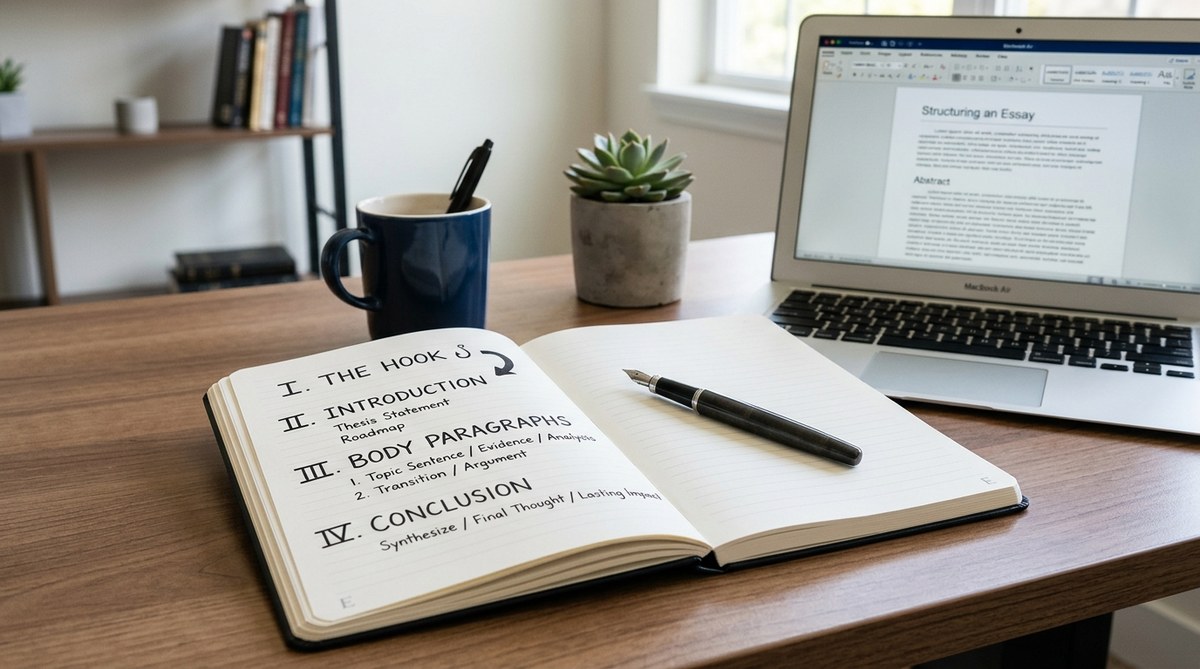
How to Structure an Essay That Captivates Your Reader from the First Sentence
You open a fresh document, cursor blinking. The blank page stares back. You know the research is solid, the argument is tight, and the conclusion will wrap everything up neatly. But that first sentence feels like a locked door. How do you pry it open and pull your reader inside?
That is where essay hooks come in. A hook is more than a pretty opener. It is a promise. It tells the reader: stay with me, this is worth your time. Without a strong hook, even the best ideas can get overlooked. With one, you grab attention from the first beat and keep your audience reading until the final period.
An essay hook is your first and best chance to make a reader care. Whether you use a startling statistic, a vivid anecdote, or a provocative question, the hook must align with your essay topic and tone. Avoid cliches, overly long setups, and generic statements. Practice writing three different hooks for every essay, then choose the strongest one. Master hooks, and you master reader engagement from the first sentence.
What Exactly Is an Essay Hook?
An essay hook is the opening line or two that snags the reader’s interest. Think of it as the bait on a fishing line. You have only a few seconds to convince a professor, admissions officer, or peer that your essay is worth their time. The hook sets the tone, establishes your voice, and points toward the main point of your paper.
A good hook does three things:
- It creates curiosity or surprise.
- It connects emotionally or intellectually with the reader.
- It flows naturally into your thesis statement.
If your first sentence makes someone want to read the second sentence, you have done your job.
Seven Types of Essay Hooks That Work in 2026
Not every hook fits every essay. The trick is matching the hook style to your topic, audience, and purpose. Below are seven widely used types, with examples you can adapt.
1. The Anecdote Hook
Start with a short, personal story. Anecdotes humanize your writing and make abstract ideas feel real. For a college essay about perseverance, you might begin:
“I stood at the starting line of my first 10K with legs that felt like jelly and a stomach full of doubt. Ten miles later, I crossed the finish line not because I was fast, but because I refused to stop.”
An anecdote works best when it mirrors the larger theme of your essay. Keep it brief, one or two sentences. Too much detail bogs down the opening.
2. The Statistic Hook
Numbers can jolt a reader awake. A startling fact or data point creates immediate impact. For an essay on screen time and mental health, try:
“The average American teenager spends over seven hours a day staring at a screen, yet only 18 percent of that time is spent on schoolwork.”
Cite credible sources. A made-up statistic erodes trust. Pair the statistic with a follow-up sentence that connects it to your thesis.
3. The Question Hook
A rhetorical question invites the reader to think. It works especially well for persuasive or argumentative essays.
“What would you do if you knew you could not fail?”
Avoid yes/no questions. They close off thought. Use open-ended questions that prompt reflection. Then answer that question in your essay.
4. The Quotation Hook
A well-chosen quote from an expert, a famous figure, or even a song lyric can set the stage. For an essay on creativity, you might begin with:
“Steve Jobs once said, ‘Creativity is just connecting things.’ I first heard that line while sitting in a cramped garage with my grandfather, surrounded by old radio parts.”
Quotes work best when they are unusual. Avoid overused lines like “To be or not to be.” Tie the quote directly to your own experience or argument.
5. The Bold Statement Hook
Make a strong claim that challenges common beliefs. A bold statement grabs attention because it dares the reader to disagree.
“Failure is not the opposite of success. It is the raw material of it.”
This hook is perfect for opinion pieces or reflective essays. Back it up with evidence in the body paragraphs.
6. The Scene-Setting Hook
Paint a picture with sensory details. Transport the reader to a specific time and place.
“The library smelled of old paper and floor wax. Sunlight fell through a crack in the blinds, landing on a dusty copy of ‘The Great Gatsby.’ I opened it, and a faded train ticket from 1985 fell into my lap.”
Scene-setting hooks are ideal for descriptive or narrative essays. Use vivid nouns and active verbs. Avoid clutter.
7. The Metaphor or Simile Hook
Compare two unlike things to create a fresh perspective. For an essay on social media algorithms, you could write:
“Social media feeds are like personalized slot machines, each swipe delivering a tiny hit of dopamine.”
Metaphors work when they are original and accurate. Overused similes (like “as busy as a bee”) fall flat.
How to Choose the Right Hook for Your Essay
Picking a hook is not random. Follow these three steps to find the best option for your assignment.
-
Identify your essay type. Argumentative essays often benefit from a statistic or bold statement. Personal essays shine with an anecdote or scene setting. Research papers pair well with a question or quotation.
-
Know your audience. Is your reader a professor expecting formal language, or an admissions officer looking for authenticity? Match your hook’s tone to your reader’s expectations.
-
Test two or three options. Write three different hooks for the same essay. Read them aloud. Which one feels most natural? Which one makes you want to keep reading? That is your winner.
Common Mistakes That Kill Your Hook
A hook can backfire if you are not careful. Avoid these pitfalls.
| What to Avoid | Why It Fails | Better Alternative |
|---|---|---|
| Cliche opener | “Since the dawn of time…” feels lazy and generic. | Start with a specific detail instead. |
| Too long | A five-sentence hook delays your thesis. | Keep it to one or two tight sentences. |
| Mismatched tone | A joke in a serious essay feels forced. | Let your hook reflect the essay’s overall mood. |
| Obvious statement | “Water is essential for life” adds nothing new. | Surprise the reader with a less obvious fact. |
| Dictionary definition | “According to Merriam-Webster, success is…” is overdone. | Use a quote, a question, or a bold claim. |
Expert advice: write your introduction last. Many professional writers draft the body of their essay first, then circle back to craft a hook that genuinely reflects what the essay is about. This approach prevents you from forcing a hook that does not fit.
A Simple Process to Write a Hook That Works
Follow these numbered steps every time you need a strong opening.
-
Brainstorm three to five ideas. Do not judge them yet. Just write potential hooks using different types: an anecdote, a question, a statistic.
-
Check alignment with your thesis. Each hook idea should lead naturally into your main argument. If the hook feels disconnected, scrap it.
-
Revise for brevity and punch. Cut every unnecessary word. A hook should be lean. “I was scared” is weaker than “My hands trembled.”
-
Read the hook aloud. Hearing the words helps you catch awkward phrasing. If it sounds clunky, rewrite it.
-
Get feedback from a peer. Ask a friend: “Would this first sentence make you want to read more?” Honest feedback saves you from blind spots.
Practical Tips for Writing Hooks That Stick
- Write your hook after the essay draft is complete. You will have a clearer sense of what the essay is truly about.
- Use active voice in your opening. “The experiment failed” is stronger than “The experiment was a failure.”
- Avoid announcing your topic directly. Do not start with “This essay will discuss…” Show, do not tell.
- Keep the hook relevant. A flashy statistic about climate change does not belong in a personal essay about learning piano.
- Revise your hook at least three times. The first version is rarely the best.
For more on strengthening your writing, check out this guide on boost your essay writing skills with proven strategies. If you are working on a persuasive piece, the article master the art of persuasive essays in simple steps offers targeted advice.
Your Turn: Put Essay Hooks into Action
You now have the tools to craft essay hooks that stop the scroll and pull readers in. The key is practice. Next time you start an essay, spend five minutes writing three different hooks. Pick the strongest one. Then revise it until it shines.
A great hook does not guarantee a great essay, but it gives your reader a reason to keep reading. And that is half the battle. So open a new document, take a breath, and write a first sentence that earns your reader’s attention. You have got this.