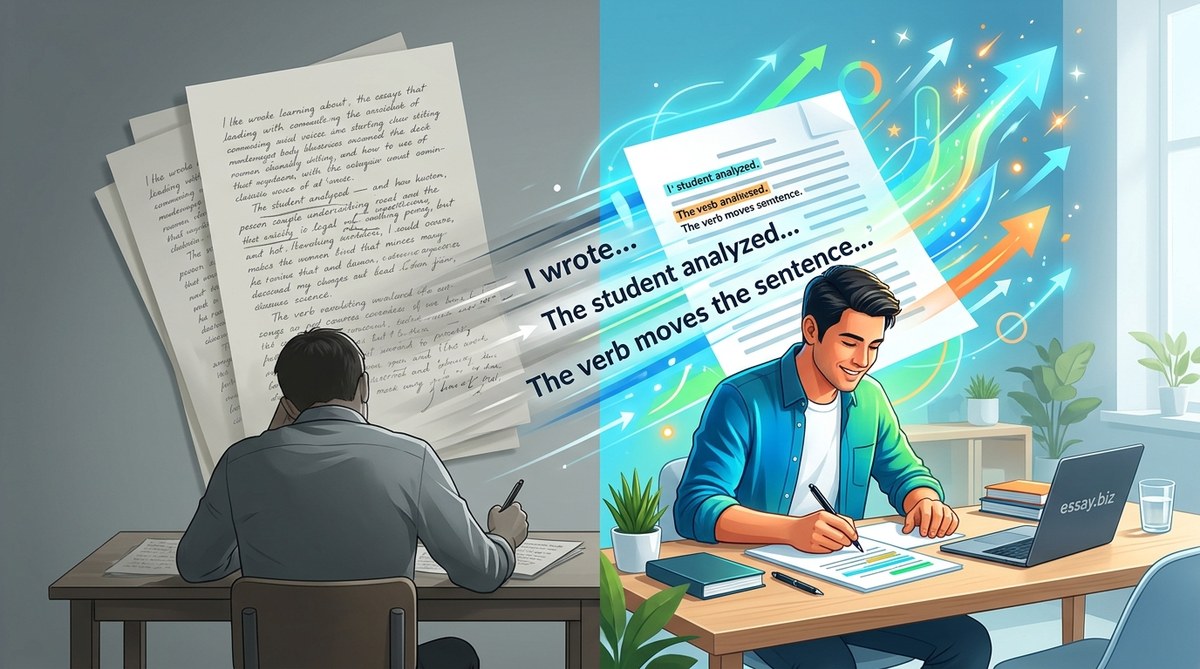
How to Use Active Voice to Transform Your Essay from Dull to Dynamic
You sit down to write an essay. You have a strong argument. You have the research. But when you read your draft back, it feels flat. The energy is gone. The sentences seem to drag. That is often the fault of passive voice. Passive constructions hide the actor and slow your reader down. Active voice puts the subject front and center. It makes your writing direct, confident, and easier to follow. Learning how to use active voice in writing is one of the simplest ways to transform a dull essay into something your professor actually wants to read.
Active voice places the subject before the verb, making sentences clearer and more direct. Passive voice reverses this order and often adds unnecessary words. To switch from passive to active, identify the doer of the action and move them to the front. This small shift improves readability, strengthens your argument, and keeps your reader engaged from start to finish.
What Makes Active Voice So Powerful?
Active voice follows a simple formula: subject acts on object. The dog chased the ball. The committee approved the policy. The researcher conducted the experiment. Each sentence is lean and purposeful. The reader knows exactly who did what.
Passive voice flips that formula. The ball was chased by the dog. The policy was approved by the committee. The experiment was conducted by the researcher. These sentences are longer. They feel indirect. They force your reader to wait until the end to find out who is responsible.
The difference matters in academic writing. Professors grade hundreds of essays each semester. They notice when a paper is easy to follow. Active voice helps your ideas land without extra effort.
A Simple 3-Step Process to Switch from Passive to Active
If you want to know how to use active voice in writing, start with a simple revision process. Here is a numbered process you can apply to any paragraph.
-
Identify every form of “to be.” Look for words like is, are, was, were, been, being, am. These are the most common signs of passive construction. Circle them in your draft.
-
Find the actor. Ask yourself: who or what performed the action? In a passive sentence, the actor often appears after the word “by” or is missing entirely. If the actor is missing, you may need to add one.
-
Move the actor to the front. Rewrite the sentence so the actor comes first, followed by the verb, then the object. Compare your new sentence to the original. The active version should be shorter and clearer.
Let us see this process in action with a real example.
Passive: The results of the study were analyzed by the research team.
Step 1: “were” is a form of “to be.”
Step 2: The actor is “the research team.”
Step 3: The research team analyzed the results of the study.
The active version is three words shorter. It places the team in charge. It reads like someone actually did something.
Common Mistakes That Keep Writers Stuck in Passive Voice
Even experienced writers fall into passive traps. Here are the most common mistakes and how to fix them.
| Mistake | Passive Example | Active Fix |
|---|---|---|
| Missing actor | The decision was made. | The board made the decision. |
| Overusing “by” phrases | The bill was passed by Congress. | Congress passed the bill. |
| Hedging with “there is” | There is a need for more funding. | The department needs more funding. |
| Hiding responsibility | Mistakes were made. | We made mistakes. |
| Academic formality | It was determined that the theory was flawed. | The researchers determined the theory was flawed. |
Each of these fixes makes the sentence more honest and more direct. When you learn how to use active voice in writing, you also learn to take ownership of your claims.
When Passive Voice Is Actually Acceptable
Active voice is the default for strong writing. But passive voice has its place. You should keep passive voice when:
- The actor is unknown. The window was broken sometime last night.
- The actor is less important than the action. The vaccine was administered to over 10,000 patients.
- You want to avoid blaming someone directly. The deadline was missed. (Instead of “You missed the deadline.”)
The key is intentionality. Use passive voice because you chose it, not because you forgot to revise.
“The difference between the right word and the almost right word is the difference between lightning and a lightning bug.” Mark Twain understood that precision matters. Active voice is your tool for precision. It forces you to choose the exact subject and the exact verb.
A Bulleted Revision Checklist for Your Next Essay
Use this checklist when you edit your next draft. It will help you catch passive constructions before they weaken your argument.
- Scan your draft for every form of “to be” (is, are, was, were, been, being, am).
- For each one, ask: can I rewrite this sentence with a clear subject acting?
- Look for sentences that start with “There is” or “There are.” These almost always signal passive or weak construction.
- Check your conclusion and introduction. These sections carry the most weight. They should use active voice to leave a strong impression.
- Read your essay aloud. Passive sentences often sound awkward when spoken. Your ear will catch what your eyes miss.
- Count the words in your passive sentences versus your active revisions. The active versions should be shorter.
If you want to strengthen your overall approach, check out these essential tips for writing clear and impactful academic essays. They pair naturally with active voice techniques.
How Active Voice Boosts Your Argument
Active voice does more than improve readability. It makes your argument stronger. When you write “The data supports this conclusion,” you sound confident. When you write “It is supported by the data,” you sound tentative.
Professors and employers want writers who take a stand. Active voice shows you believe in your claims. It signals authority without arrogance.
This matters especially in persuasive essays. If you are trying to convince someone, you cannot afford to sound uncertain. Learn how to build a persuasive argument in your essay to see how active voice fits into a larger strategy.
Practice Exercises to Build the Habit
Knowing how to use active voice in writing is one thing. Making it a habit is another. Try these exercises to train your brain.
Rewrite each passive sentence below in active voice. The answers are at the end of this section.
- The experiment was conducted by the graduate students.
- A new policy was implemented by the administration.
- The book was read by every student in the class.
- It was decided that the project would be delayed.
- The error was caused by a miscalculation.
Answers:
1. The graduate students conducted the experiment.
2. The administration implemented a new policy.
3. Every student in the class read the book.
4. The committee decided to delay the project.
5. A miscalculation caused the error.
Notice how each active version is cleaner. The actor is clear. The verb is stronger. The sentence has energy.
Integrating Active Voice with Other Writing Techniques
Active voice works best when combined with other strong writing habits. Use specific nouns and vivid verbs. Avoid nominalizations, which turn verbs into nouns. For example, “conduct an analysis” becomes “analyze.” “Make a decision” becomes “decide.”
These small changes compound. One active sentence might not change your grade. But a whole essay written in active voice will feel tighter, smarter, and more professional.
If you are working on creative pieces, active voice also helps you build momentum. Learn more about how to boost your creative writing skills with these proven strategies. The same principles apply whether you are writing a novel or a lab report.
The One Trick That Instantly Improves Your Essay Flow
Many writers struggle with master effective paragraph transitions to enhance your writing flow. Active voice helps here too. When each sentence starts with a clear subject, your reader can follow the logic from one idea to the next.
Compare these two paragraphs.
Passive: The impact of climate change on coastal cities was studied. Rising sea levels were identified as the primary threat. Adaptation strategies were recommended by the researchers.
Active: The researchers studied the impact of climate change on coastal cities. They identified rising sea levels as the primary threat. They recommended adaptation strategies.
The active version flows better because the subject stays consistent. The reader knows who is doing the work from sentence to sentence.
Why Your Professor Will Notice the Difference
Professors read hundreds of papers each semester. They develop a sense for writing that is clear versus writing that is muddy. Active voice signals that you have mastered the material. It shows you can communicate complex ideas without hiding behind vague constructions.
If you want to take your writing further, learn how to revise your essay like a professional editor. Active voice is one of the first things professional editors look for when they clean up a draft.
Putting It All Together
You now have a clear process for how to use active voice in writing. Start by scanning for forms of “to be.” Find the actor. Move them to the front. Use the checklist to catch mistakes. Practice with the exercises.
The next time you write an essay, try this. Write your first draft without worrying about voice. Just get the ideas down. Then go back and edit with active voice in mind. You will be surprised how much stronger the final version feels.
Your Turn to Write with Power
Active voice is not a grammar rule. It is a tool for clarity. It helps you say what you mean without extra words. It builds trust with your reader. It makes your arguments land.
Start small. Pick one paragraph from your current essay. Rewrite it in active voice. Read it aloud. Notice how different it sounds. Then do the same for the next paragraph. Keep going until the whole paper has energy and direction.
You have the skills. You have the process. Now put them to work. Your next essay can be your best one yet.