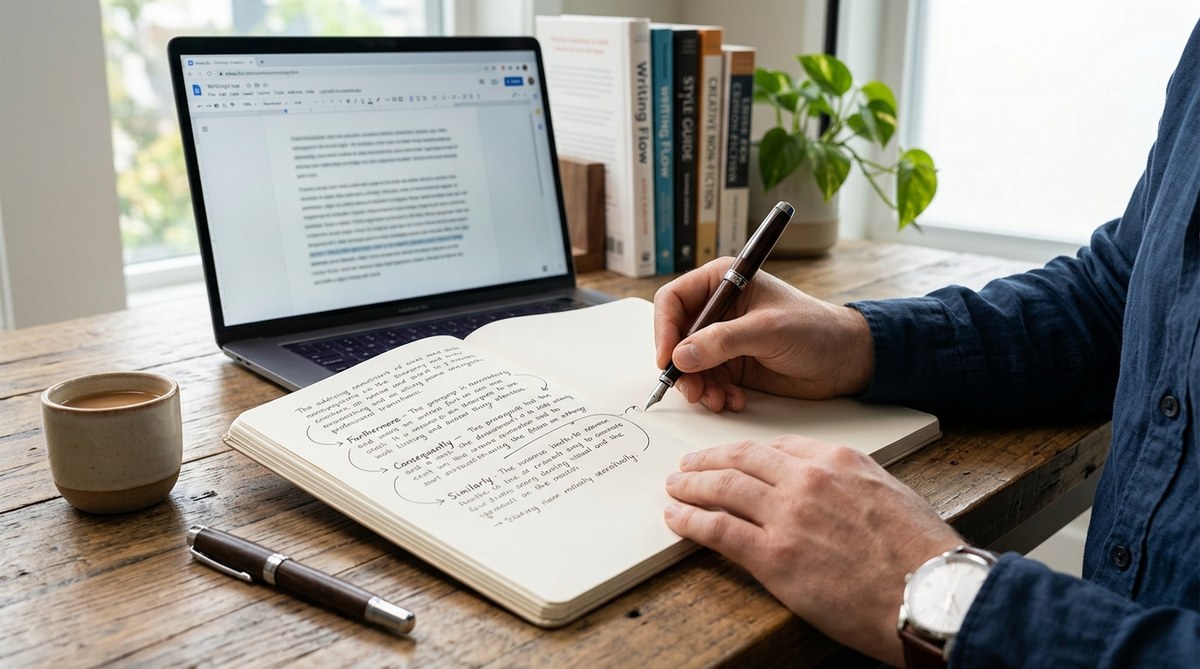
Master Effective Paragraph Transitions to Enhance Your Writing Flow
Writing can feel like a puzzle. You want your ideas to connect seamlessly, guiding your readers effortlessly from one paragraph to the next. That’s where paragraph transitions come in. They act as bridges, helping your writing flow naturally and making your arguments more persuasive. When used well, transitions prevent your work from feeling choppy or confusing. Instead, they create a smooth journey for your readers, keeping them engaged from start to finish.
Effective paragraph transitions are essential for guiding your readers through your ideas smoothly. They connect your thoughts clearly, improve your writing flow, and make your arguments more compelling. Mastering different transition techniques can elevate your writing from good to great, ensuring your message is understood and appreciated.
Why paragraph transitions matter in writing
At their core, paragraph transitions serve to link ideas within and between paragraphs. Without them, your writing can feel disjointed, causing readers to stumble or lose interest. Think of transitions as signposts that tell your audience what to expect next. They highlight shifts in thought, contrast, or emphasis, making your writing more cohesive and persuasive.
Imagine reading a story or an essay where each paragraph suddenly jumps to a new topic without warning. It can be jarring. Transitions ease that jump, providing a gentle nudge that guides your reader along your thought process. Whether you’re arguing a point, explaining a concept, or narrating an event, transitions help your writing flow smoothly.
Types of paragraph transitions and how to use them
There are several types of transitions, each serving a different purpose. Understanding these can help you craft more cohesive paragraphs.
1. Transitions for adding information
These transitions show that you’re continuing a thought or adding details.
- Examples include: furthermore, in addition, also, moreover, besides
Example:
“Climate change is a pressing issue. Moreover, its effects are already visible worldwide.”
2. Transitions for contrast
Use these to highlight differences or oppositions.
- Examples include: however, on the other hand, in contrast, but, yet
Example:
“Public transportation is affordable. However, it may not be convenient for everyone.”
3. Transitions for cause and effect
These show relationships between actions and outcomes.
- Examples include: therefore, thus, as a result, consequently, hence
Example:
“She studied diligently. As a result, she scored the highest on the exam.”
4. Transitions for comparison
Compare two ideas or concepts.
- Examples include: similarly, likewise, in the same way, just as
Example:
“Cats are independent animals. Similarly, dogs can also be quite self-reliant.”
5. Transitions for sequence or order
Indicate steps or progression.
- Examples include: first, next, then, finally, afterward
Example:
“First, gather all necessary materials. Next, follow the instructions carefully.”
6. Transitions for emphasis
Highlight important points.
- Examples include: indeed, in fact, notably, especially
Example:
“Many students struggle with calculus. In fact, it is considered one of the most challenging subjects.”
How to incorporate paragraph transitions effectively
Using transitions isn’t just about inserting a word or phrase. It requires understanding your flow and choosing the right link for the situation. Here are steps to help you integrate transitions smoothly:
-
Identify the relationship between your ideas. Are you adding, contrasting, explaining, or sequencing?
-
Choose the appropriate transition based on that relationship.
-
Position the transition where it makes the most sense—at the beginning of the new paragraph or within the paragraph to connect ideas.
-
Vary your transitions to avoid repetition and keep your writing engaging.
Practical process for using paragraph transitions
-
Read your draft aloud. Notice where the flow feels abrupt or disjointed.
-
Highlight the points where you need to clarify connections.
-
Select appropriate transition words or phrases to bridge those ideas.
-
Rewrite those sections by inserting transitions naturally.
-
Review and refine your transitions for clarity and smoothness.
Common pitfalls and how to avoid them
| Technique or mistake | What to do | What to avoid |
|---|---|---|
| Overusing transitions | Use them sparingly for emphasis | Filling every sentence with transition words |
| Using vague transitions | Be specific about the relationship | Using “and” or “then” excessively without clarity |
| Forcing transitions | Make sure they fit logically | Inserting transitions where they don’t make sense |
| Repeating the same transition | Vary your language | Relying on “however,” “also,” repeatedly |
“A good rule of thumb is to read your writing aloud. If a transition sounds forced or unnecessary, rework it so that your ideas flow naturally.” – Writing expert
Practical techniques to improve your paragraph flow
- Use signposting phrases that guide your reader through your argument. For example, “to illustrate,” “considering the fact that,” or “as previously mentioned.”
- Employ linking words within sentences to clarify relationships.
- Vary your transitions to keep your writing lively and engaging.
- Be intentional. Not every paragraph needs a transition, only ones where the connection isn’t obvious.
Transition techniques and common mistakes table
| Technique | How it works | Mistake to avoid |
|---|---|---|
| Sequential transitions | Use to show order | Using “then” excessively without context |
| Contrast transitions | Highlight differences | Overusing “but” or “however” in quick succession |
| Addition transitions | Build upon previous ideas | Relying solely on “and” or “also” without clarity |
| Cause and effect | Show relationships | Ignoring the logical connection when using “therefore” |
Expert advice on mastering paragraph transitions
“Effective transitions are like road signs in your writing. They tell your readers where you’re headed and how your ideas connect. Take the time to choose your transitions carefully, and your writing will flow much more naturally.” – seasoned writing coach
Putting it all together for better writing
Remember, mastering paragraph transitions is a skill that improves with practice. Focus on understanding how your ideas relate and select transitions that clarify these relationships. Read your work aloud, revise where necessary, and don’t be afraid to experiment with different transition words. Over time, you’ll develop a natural sense for when and how to use them, making your writing clearer and more persuasive.
Keep your writing seamless with thoughtful transitions
Transitions are more than just words; they are the glue that holds your ideas together. When used intentionally, they transform a series of disconnected thoughts into a cohesive story or argument. As you write, think about the flow—how one paragraph leads into the next—and choose your transitions accordingly. Your readers will thank you for the clarity and smoothness your thoughtful connections create.
Happy writing! With practice and patience, your paragraphs will flow effortlessly, making your work engaging and easy to follow.
