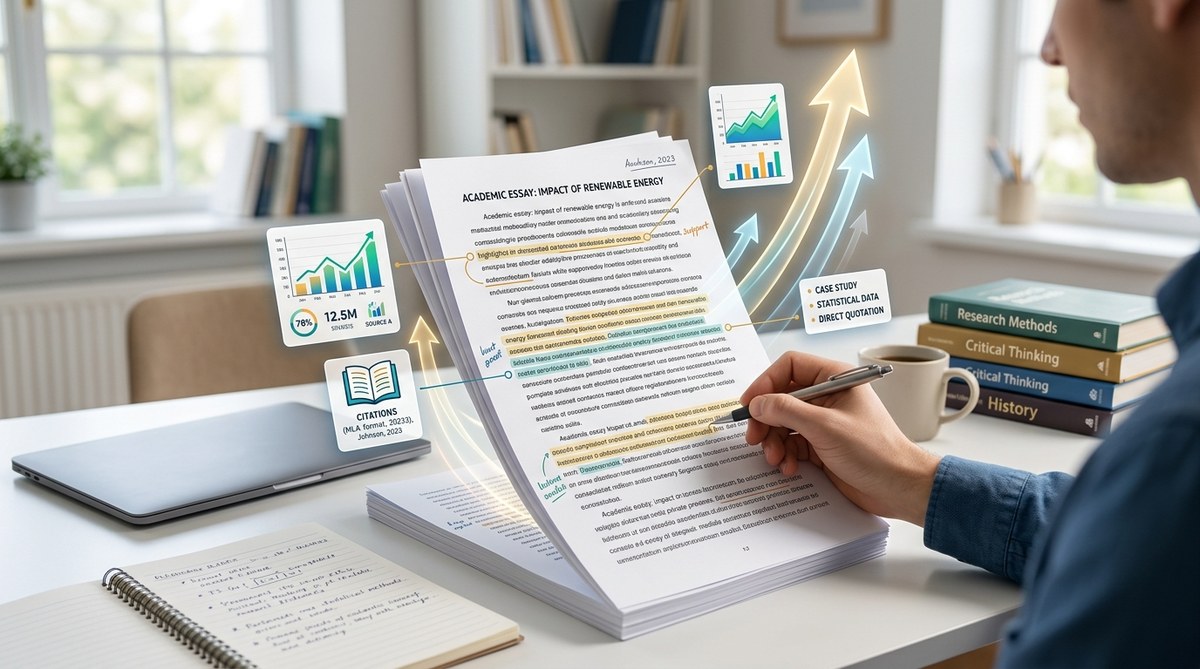
How to Elevate Your Essay with Powerful Evidence and Examples
Your essay claims need proof. That is where evidence comes in. Without it, your arguments are just opinions. Strong evidence turns a good essay into a great one. It shows your reader that you have done the work and that your ideas are backed by real sources. Learning how to use evidence in an essay is a skill that will serve you through high school, college, and beyond. In this guide, we will walk through everything you need to know: what counts as evidence, how to weave it into your paragraphs, and how to avoid the traps that lower grades. By the end, you will feel confident supporting every claim you make.
Using evidence well means picking the right sources, introducing them clearly, and connecting each piece back to your main argument. Follow a three-step process: state your claim, present the evidence, then explain how it supports your point. Avoid dropping quotes without context. Practice these habits, and your essays will gain authority and clarity.
What Counts as Evidence?
Not every piece of information works as evidence. Professors and teachers look for material that is credible, relevant, and current. In most academic essays, you will rely on these types:
- Peer reviewed journal articles – These are studies or analyses written by experts and checked by other experts. They are the gold standard in academic writing.
- Books from reputable publishers – University presses, established academic publishers, and well known nonfiction houses.
- Government reports and official statistics – Data from sources like the U.S. Census Bureau, the Bureau of Labor Statistics, or the Centers for Disease Control.
- Reputable news outlets – For example, The New York Times, The Wall Street Journal, or NPR. Use these for current events and expert commentary.
- Primary sources – Original documents, letters, speeches, interviews, or raw data. These are especially important in history and literature essays.
- Expert interviews – If you conduct your own interviews, they can count as original evidence.
Avoid using Wikipedia as a cited source. Use it to find the original sources at the bottom of each page. Also avoid personal blogs, opinion pieces without fact checking, and outdated material (generally anything older than ten years unless it is a classic work).
The Three Step Process to Add Evidence
Every time you include evidence, follow this simple process. It will keep your paragraphs focused and your argument strong.
- Introduce the claim. Start the sentence with your own idea. For example: “The increase in screen time has been linked to lower sleep quality among teenagers.” This is your argument.
- Present the evidence. Now back up that claim with a specific source. “According to a 2025 study published in the Journal of Adolescent Health, teenagers who spent more than three hours a day on social media reported 45 minutes less sleep per night on average.”
- Explain the connection. This is the most crucial step. Do not assume your reader sees the link. Write something like: “This data shows that the relationship between screen time and sleep is not just anecdotal. When teenagers use social media heavily, their sleep suffers in a measurable way, which can affect their grades and mood.”
This three step pattern is often called the “claim evidence analysis” sandwich. It makes your writing clear and persuasive.
How to Introduce Evidence
The words you use to bring in evidence matter. They signal to your reader that you are about to present support. Below are useful phrases grouped by the type of evidence you are using.
- For direct quotes: “As Smith argues, …” “In the words of researcher Maria Lopez, …” “The author states that …”
- For paraphrased ideas: “According to a 2024 study by the Pew Research Center, …” “Jones finds that …” “Research from Stanford University suggests …”
- For statistics: “Data from the U.S. Department of Education shows that …” “The numbers indicate …” “On average, students who … scored 15% higher.”
- For established facts: “It is widely accepted that …” “Historians agree that …” “A growing body of research confirms …”
Choose a variety of phrases so your writing does not become repetitive. And always make sure the phrase matches the type of source you are citing.
Common Mistakes vs. Best Practices
Many students lose points because of how they handle evidence. The table below shows the most frequent errors and how to fix them.
| Mistake | Why It Hurts Your Essay | Best Practice |
|---|---|---|
| Dropping a quote without context | The reader does not know why the quote is there. | Always introduce the quote and explain its relevance. |
| Using evidence that does not match your claim | The argument becomes weak and confusing. | Double check that every piece of evidence directly supports the point you are making. |
| Overquoting | Your own voice disappears. | Use quotes sparingly. Paraphrase most sources and save quotes for especially powerful language. |
| Citing a low quality source | Your credibility drops. | Stick with peer reviewed journals, reputable news outlets, and official reports. |
| Forgetting to cite the source | This is plagiarism, even if unintentional. | Keep track of your sources from the start. Use a citation tool like Zotero or EasyBib. |
| Only using one type of evidence | Your argument feels one sided. | Mix statistics, expert opinions, and real world examples for a richer argument. |
Expert Advice on Using Evidence
“The best essays do not just list facts. They build a conversation between the writer and the sources. When you use evidence, ask yourself: ‘How does this source help me prove my thesis? What new insight does it offer?’ The strongest paragraphs are the ones where the evidence and the writer’s own analysis are woven together seamlessly.”
– Dr. Rebecca Tan, Professor of English, University of Michigan
This advice highlights an important point: evidence is not decoration. It is a tool to move your argument forward. Always connect it back to your main idea.
Putting It All Together: A Sample Paragraph
Let us see the three step process in action.
Claim: Banning single use plastic bags in grocery stores leads to a measurable reduction in plastic waste.
Evidence: According to a 2026 report from the California Environmental Protection Agency, stores that replaced plastic bags with paper and reusable options saw a 72% drop in plastic bag litter along the coast within two years.
Explanation: This statistic demonstrates that a policy change at the store level has real environmental benefits. When customers cannot get a plastic bag, they adapt by bringing their own or using paper, and the litter problem decreases sharply. Similar results have appeared in other states that adopted bans.
Notice how the writer does not just drop the statistic. They explain what it means and why it matters for their argument. That is the key to using evidence effectively.
Your Turn: Build Stronger Arguments Today
You now have the tools to use evidence like a strong writer. Start with a clear claim. Find a credible source. Introduce it with a natural phrase. Then explain how it supports your point. Avoid common pitfalls like overquoting or using weak sources.
Practice this skill on your next essay. Pick one body paragraph and apply the three step process. Read it out loud. Does the evidence feel like a natural part of your argument? If not, adjust the explanation until it flows.
For more help, check out our guide on how to build a persuasive argument in your essay. And remember: every strong essay starts with one solid paragraph. You can build from there.
