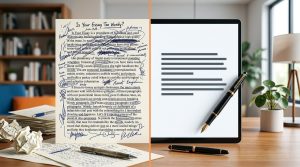
How to Revise Your Essay Like a Professional Editor
You just finished writing your essay. It feels good. Then you read it again and notice clunky sentences, a weak thesis, and paragraphs that wander. This is where the real work begins. Learning how to revise an essay is the skill that separates average papers from memorable ones. Professional editors don’t just fix commas; they reshape arguments, tighten logic, and make every sentence pull its weight. You can do the same without a fancy degree.
Revising an essay means rethinking your entire paper, not just fixing errors. Start by stepping away from your draft. Then read for overall argument strength. Check your thesis, paragraph structure, and evidence. Cut unnecessary words. Finally, proofread for grammar. This process turns a C paper into an A by making your ideas clear and persuasive.
Why Revision Matters More Than You Think
Many students treat revision as a quick spell check. That’s a mistake. Revision is where your ideas get sharper and your voice gets stronger. A solid revision can raise your grade by a full letter, sometimes more. It also helps you understand your own argument better. When you revise like an editor, you catch contradictions, fill gaps, and remove fluff. You build credibility with every change.
Here are common beliefs about revision that hold students back:
- Belief: Revision is just fixing typos.
Truth: Revision reworks the whole paper, from thesis to final sentence. - Belief: You should edit as you write.
Truth: That slows you down and kills creativity. Write first, revise later. - Belief: A second draft is enough.
Truth: Most professional essays go through four or more rounds.
If you want to improve your writing skills beyond revision, check out https://essay.biz/boost-your-essay-writing-skills-with-proven-strategies/ for a broader set of strategies.
The 7 Step Editorial Process for Revising Your Essay
Professional editors follow a repeatable system. Here is a process you can use every time. It moves from big picture to small details.
-
Step away from your draft. Take at least one hour, ideally overnight. Fresh eyes catch problems you miss when you are too close to the text.
-
Read for the big picture. Ignore grammar. Focus on your thesis and main argument. Does every paragraph support your thesis? Does the essay answer the prompt fully? Note any weak spots.
-
Strengthen your thesis. A weak thesis makes the whole essay wobble. Make sure it is specific, arguable, and clear. If you need help writing a better thesis, see
-
Check your structure. Look at the order of your paragraphs. Does the argument flow logically? Can you rearrange sections to make the progression more natural? Sometimes the second paragraph should be the third.
-
Refine each paragraph. Every paragraph should have one clear point. Start with a strong topic sentence. Add evidence and analysis. Cut any sentence that does not support that point. For more on building strong body paragraphs, read
-
Polish your sentences. Now you get to the line level. Cut unnecessary words. Change passive voice to active where it improves clarity. Vary sentence length to keep the reader engaged.
-
Proofread for grammar and typos. Do this last. Read your essay out loud or backwards to catch errors. Use a tool like Grammarly as a backup, but never rely on it alone.
Following these steps in order saves time and produces better results. Jumping straight to proofreading is the fastest way to miss big issues.
Common Revision Mistakes and How to Fix Them
Even experienced writers fall into traps. Here is a table of the most frequent revision mistakes and what to do instead.
| Mistake | Why It Hurts | How to Fix |
|---|---|---|
| Editing while writing | Stops your creative flow and leads to unfinished drafts | Write freely first, then revise. Separate the two tasks. |
| Ignoring the thesis | The essay lacks direction and feels scattered | Revise your thesis first. Then check each paragraph aligns with it. |
| Overusing passive voice | Makes writing weak and indirect | Change at least half of your passive sentences to active. |
| Keeping every sentence | Clogs your paragraphs with filler | Cut any sentence that does not add new information or analysis. |
| Proofreading too early | You waste time polishing content that may be cut later | Save proofreading for the last step. |
If you are making several of these mistakes, you are not alone. Many students do. The fix is to slow down and follow the step-by-step process above. For a deeper look at structural problems, see
How to Revise Your Essay Like a Professional Editor
Here is a checklist you can print or keep open while you work. It covers the main moves an editor makes.
- [ ] Read the essay out loud. It reveals awkward phrasing and rhythm issues.
- [ ] Highlight your thesis. Make sure it appears early and clearly.
- [ ] Underline the topic sentence of each paragraph. If a paragraph lacks one, rewrite it.
- [ ] Circle every transition word. Do they guide the reader smoothly? Add or remove as needed.
- [ ] Count repeated words. Replace them with synonyms or restructure sentences.
- [ ] Look for filler phrases like “in order to,” “due to the fact that,” or “it is important to.” Delete them.
- [ ] Check your conclusion. It should reinforce your thesis, not introduce new ideas.
- [ ] Verify your formatting matches guidelines (font, margins, citations).
For essays that demand persuasive power, https://essay.biz/master-the-art-of-persuasive-essays-in-simple-steps/ can help you build stronger arguments.
Expert Advice from Real Editors
“The best revision advice I ever got was ‘kill your darlings.’ If a sentence or paragraph is beautiful but does not serve your argument, cut it. Your essay will be stronger without it. Also, always read your essay from the perspective of a reader who knows nothing about your topic. Does everything make sense? That is the true test.” — Sarah L., Senior Editor at a university writing center.
This advice cuts to the heart of revision. You have to be honest with yourself. Every part of the essay should pull in the same direction. If a section feels off, do not ignore it. Fix it.
For college application essays, where every word matters, https://essay.biz/how-to-write-a-winning-college-essay-in-2026/ offers targeted advice.
Crafting Your Personal Revision Workflow
The process I shared works, but you should adapt it to your own style. Maybe you need two rounds of big picture reading. Maybe you prefer to print your essay and write notes in the margins. That is fine. The key is to have a system that you follow every time.
Here is how to build your own workflow:
- Decide the number of revision rounds. Most essays need at least three: one for structure, one for paragraphs, one for sentences.
- Set a timer for each round. For example, 15 minutes for big picture, 20 minutes for paragraphs, 10 minutes for proofreading.
- Take breaks between rounds. Your brain needs rest to stay sharp.
- Get feedback from a peer or a tutor. Fresh eyes catch things you miss. Use their feedback to guide your final revision.
Revision is a skill that improves with practice. The more you do it, the faster and better you become. Soon you will spot problems before you even finish your first draft. But you have to start by doing the work. Open your essay right now. Read it aloud. Mark one thing to change. Then change it. That is how you revise like a professional.